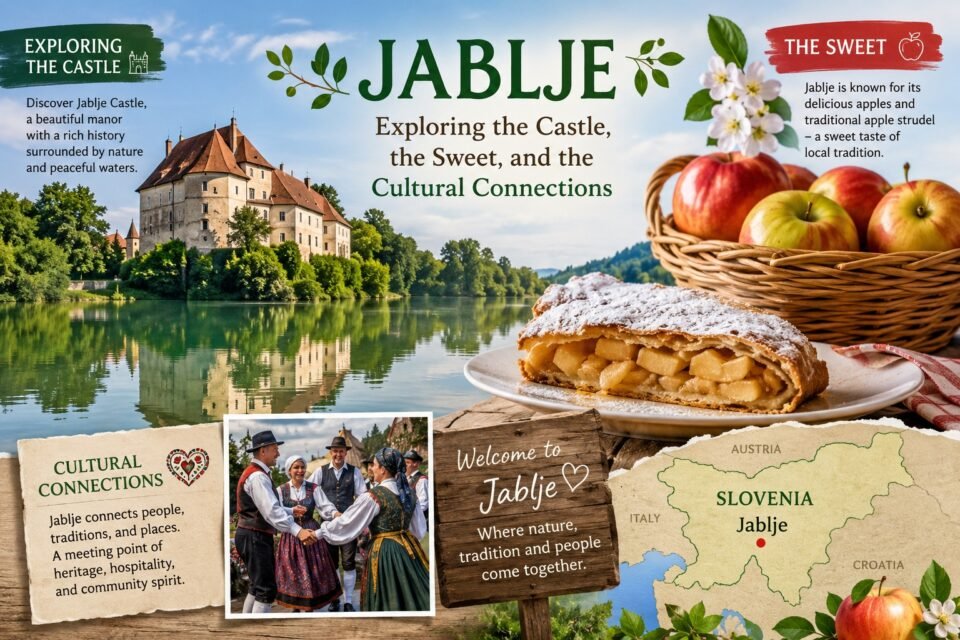

In the world of internet searches, few terms are as delightfully confusing as jablje. Depending on where you look and what language you speak, jablje can refer to a historic Renaissance castle in Slovenia, a misspelling of the beloved South Asian sweet jalebi, or even the Czech word for apple. This article explores the multiple meanings of jablje, diving into each interpretation and tracing the fascinating connections between these seemingly unrelated subjects.
Read :Cadibara
What Is Jablje? The Many Meanings
Jablje does not have a single, universal meaning. Instead, it is a term that appears in different contexts across languages and cultures. The most prominent meanings include:
| Meaning | Context | Key Feature |
|---|---|---|
| Jablje Castle | Slovenian history and tourism | A Renaissance castle near Ljubljana with original 18th-century frescoes |
| Misspelling of Jalebi | South Asian cuisine | A popular syrupy sweet, often misspelled as “jablje” |
| Czech/Slavic root for apple | Linguistics | Related to words like “jablko” (apple) and “jabloň” (apple tree) |
Understanding which meaning someone intends depends entirely on the context of the conversation or search.
Jablje Castle: A Slovenian Renaissance Treasure
The most historically significant meaning of jablje refers to Jablje Castle (Slovene: Grad Jablje, also spelt Jable, German: Schloss Habach). This castle sits above the settlement of Jablje near Loka pri Mengšu, Slovenia, at the western edge of the Mengeš plain .
Location and Accessibility
Jablje Castle is located in the village of Loka pri Mengšu, in the foothills of the Kamnik-Savinja Alps in central Slovenia. It is roughly 10 km northeast of Ljubljana, making it one of the closest historic castles to the capital. The drive takes about 15 to 20 minutes .
A History Spanning Centuries
The site of a fortification at Jablje appears in records as early as 1268, referring to an earlier stronghold. In the early 1300s, the place-name appeared in German forms such as Hagbach and Hagwach, later seen as Hawach in 1348 and Habach in 1435 .
Around 1530, the noble house of Lamberg erected the present Renaissance castle. Ownership then passed through the Rasp family and later to the Mosconi barons. From 1780, the Lichtenberg barons held the property, and they remained owners until the end of World War II .
The building survived the wartime period with its fabric largely intact.In the years after the war, the state seized the castle, looters stripped it of its valuables, and authorities subdivided it into residential apartments. It later served as an experimental facility attached to the Biotechnical Faculty of the University of Ljubljana .
Restoration and Current Status
Between 1999 and 2006, the complex underwent a comprehensive restoration. During Slovenia’s presidency of the European Union in 2008, the site was used for official functions. The castle is now listed as a cultural monument and houses the Center for European Perspective .
From the outside, the structure is a rectangular Renaissance building with a stone arcaded courtyard, restored towers, and thick walls. It does not look theatrical or over-restored. looks like a real building with real age, which is exactly what it is . It survived wars, neglect, and centuries of ownership changes, and it still holds original frescoes painted by one of Slovenia’s most celebrated Baroque artists. A natural spring flows on the grounds next to it .
The Jablje Bronze Sword
Adding to the historical significance of the location, a remarkable archaeological find was discovered near Jablje Castle. A solid-hilted bronze sword from Jablje, dating to the 16th century BC, is one of the oldest European swords ever found .
Comparable swords have been found north of the Alps and in the central Danube valley. In terms of the blade shape, and even more the extremely skillfully engraved decoration of thin lines forming complex geometric motifs, it is similar to slightly older but smaller daggers from the Early Bronze Age. Swords at that time were individually crafted works of art, and this was certainly the case with the Jablje sword—nothing entirely similar has been found .
Swords with fully forged metal handles from the middle of the second millennium BC are in themselves extremely rare. The Jablje sword is the only one found so far in Slovenia. It was found in a spring near Castle Jablje, likely placed there as part of purifying or thanksgiving rituals .
Jablje vs. Jalebi: A Sweet Misspelling
For many online searchers, jablje is actually a common misspelling of jalebi—the beloved syrupy sweet popular across South Asia and the Middle East.
What Is Jalebi?
Jalebi is a deep-fried sweet made from maida flour (refined flour) that is then soaked in sugar syrup . It is shaped like a slightly large, chaotic pretzel and has a bright orange or yellow color . A well-made jalebi has a tart element balanced with a sweet taste .
Origins and History
The name “jalebi” is itself a corruption of the Arabic zalabiya or Persian zoolabiya. People enjoy versions of it all over the Middle East. In Afghanistan, locals traditionally serve jalebis with fish in the winter.In Iran, it is a festive dish and also served to the poor during Ramadan. It even finds mention in the famous Tales of Thousand and One Nights .
The origins of jalebi have been traced back to ancient India, where it was called Kundalika or Jal-vallika. People gave this name because the sweet was full of watery syrup.. Jal-vallika then became Jalebi in later dialects sometime during the period of Muslim rule, through trade and cultural exchanges with the Indian subcontinent .
Varieties Across Regions
There are many varieties of jalebis within India:
Imarti (North India): Made from urad dal paste, drier than jalebis, and considered a royal food item .
Jangiri (South India): Similar to Imarti, made from urad dal paste .
Angoor Aana (Bengal): Another variant from the eastern region .
Chhena Jalebi (Bengal): Called Omrimti, made with chhena or paneer .
Keshar Jalebi (Benares): Made with plenty of saffron .
Jalebi in Popular Culture
Jalebi is the “celebration sweet of India,” especially during national holidays like Independence Day and Republic Day, served in government offices, defense establishments, and other organizations . In North India, it is often consumed with rabri (condensed milk), and the combination of rabri-jalebi is legendary . In some parts of Pakistan, jalebi is even used as a remedy for headaches, where it is placed in boiling milk and left to stand before eating .
The Linguistic Connection: Jablje and Apples
The third meaning of jablje connects to the world of linguistics and the Slavic word for apple.
The Czech Connection
In Czech, the word for apple is jablko. The word for apple tree is jabloň. The term jablje appears as a root in various Slavic languages related to apples. For instance, the Czech word for tomato is rajče, which comes from the older term rajské jablko meaning “paradise apple” .
The Etymology of Jablje Castle
Interestingly, the name of Jablje Castle itself may have linguistic roots connected to apple trees. In the 1600s, the Slovene form Ablah was recorded by Johann Weikhard von Valvasor. While older explanations linked the Slovene name to the German Habach (derived from Habicht meaning northern goshawk), more recent interpretation holds that the Slovene name grew independently from a native root meaning “apple tree,” evolving into Jablje .
Conclusion: Embracing the Diversity of Jablje
The term jablje is a fascinating example of how language, history, and culture intersect in unexpected ways. It represents:
A historic Slovenian castle with roots dating back to the 13th century and a remarkable Renaissance structure that survived centuries of change .
An archaeological treasure, as the site of one of Europe’s oldest bronze swords, dating to the 16th century BC .
A misspelling of jalebi, one of South Asia’s most beloved sweets with a history spanning centuries and continents .
A linguistic root connected to the word for “apple” in Slavic languages .
Whether you are a history enthusiast planning a visit to Slovenia, a food lover searching for the perfect jalebi recipe, or a linguistics student tracing the roots of Slavic words, jablje offers a rich and diverse tapestry of meanings. This single word unlocks multiple cultures, histories, and traditions—each inviting you to explore