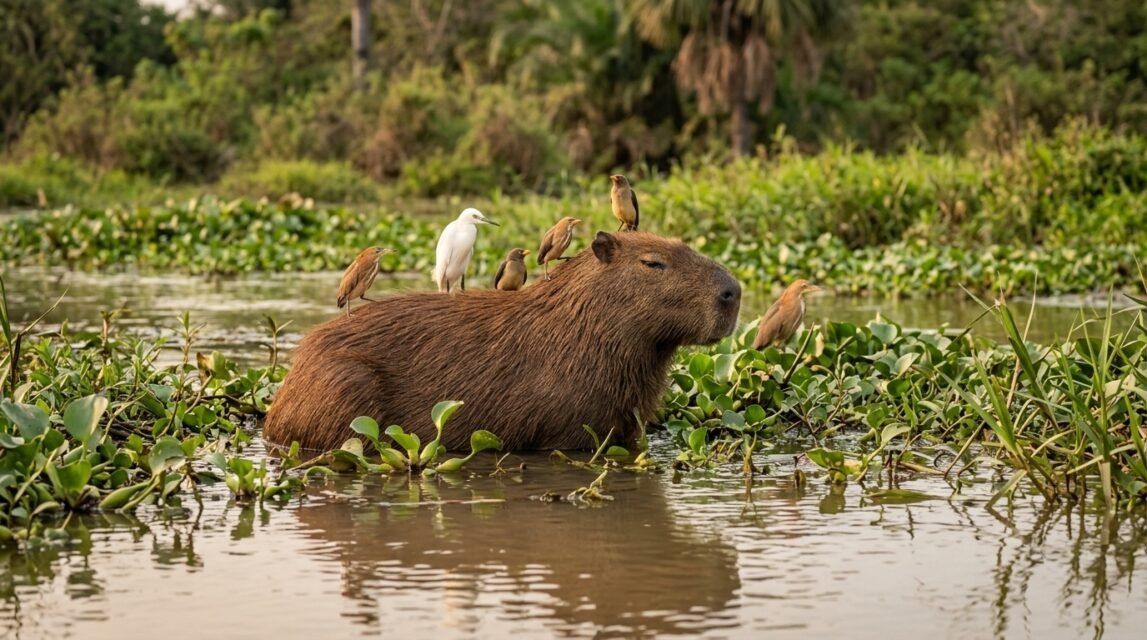

In the vast and often chaotic landscape of social media, a particular word has been quietly taking over our feeds, bringing with it a sense of peace and calm. That word is Cadibara. You have likely seen the memes, the short video clips, or the fan art featuring a large, brown, block-shaped rodent looking utterly unbothered by the world around it. While your autocorrect might try to change it to “Capybara,” the internet has collectively decided that Cadibara is not just a typo but a title—a title belonging to the world’s largest rodent and, quite possibly, the world’s chillest animal.
But what exactly is a Cadibara? Is it a different species from the capybara? Where does it live, and why has it become a symbol of tranquility in the digital age? This article dives deep into the biology, habitat, and surprising cultural rise of the Cadibara—the gentle giant that has captured our hearts.
Read: Valplekar
What is a Cadibara? Unveiling the “Internet Name”
To put it simply, a Cadibara is a capybara. The word Cadibara does not refer to a new scientific discovery or a different genetic variant of the rodent family. Instead, it is a phonetic, internet-born variation of the word “Capybara” .
The scientific name for this animal is Hydrochoerus hydrochaeris, which comes from Greek words meaning “water hog.” However, for the average person scrolling through TikTok or Instagram, Cadibara feels more accurate. The name rolls off the tongue with a soft, gentle rhythm that mimics the animal’s laid-back demeanor. While “capybara” is the standard English spelling derived from the Tupi language (ka’apiûara meaning “grass eater”), Cadibara has emerged as a popular alternate spelling that highlights how the word sounds when spoken quickly or affectionately .
So, if you search for Cadibara, you are looking for the capybara. But as we will see, Cadibara has taken on a meaning of its own—one that describes a specific vibe as much as a specific animal.
Physical Characteristics: Built for Relaxation and Rivers
If you look at a Cadibara, the first thing you notice is its shape. It has a heavy, barrel-shaped body that sits low to the ground. Adults typically weigh between 35 and 66 kilograms (77 to 146 pounds) and can stand about 50 to 60 centimeters tall at the shoulder. They are essentially the size of a medium dog, but with the face of a friendly, overgrown guinea pig .
The Cadibara has coarse, brownish fur that is surprisingly wiry to the touch. This fur is perfectly adapted to its semi-aquatic lifestyle. Because they spend a lot of time in the water, their fur dries quickly. They have partially webbed feet, turning their paws into efficient little paddles for swimming.
One of the most distinctive features of the Cadibara is the placement of its eyes, ears, and nostrils. These features are set high up on the top of its head. This adaptation allows the Cadibara to keep its entire massive body submerged beneath the water to hide from predators like jaguars and anacondas, while still being able to breathe, see, and smell the world above the surface . It is the ultimate survival mechanism that also looks incredibly funny, as the Cadibara appears to be just a floating head with a nose.
Habitat: The Wetlands of South America
The Cadibara is native to South America and can be found in almost every country on the continent except for Chile. Their range stretches from Panama down through Brazil, Venezuela, Colombia, Argentina, and Uruguay .
However, you cannot just find a Cadibara anywhere. They are strictly tied to water. Cadibaras are semi-aquatic mammals, meaning their survival depends on access to rivers, lakes, swamps, and flooded savannas. They prefer dense vegetation near water sources where they can easily hide from predators. The Amazon basin and the Pantanal—the world’s largest tropical wetland—are strongholds for the Cadibara population.
Because they rely on water to escape danger and regulate their body temperature, a Cadibara will rarely venture more than a few hundred meters from a reliable water source. In recent years, as urban development expands, Cadibaras have shown remarkable adaptability, sometimes being spotted in parks or golf courses that feature large lakes, much to the delight of local residents.
The Social Life: Why Cadibaras Are Everyone’s Friend
Perhaps the main reason the Cadibara has become an internet icon is its social behavior. Cadibaras are extremely gregarious animals. They live in groups, or herds, typically ranging from 10 to 20 individuals, though some groups can swell to over 100 during the dry season when resources are concentrated around shrinking water holes .
A Cadibara herd is usually dominated by a single alpha male, but the group dynamics are surprisingly peaceful. They communicate through a series of vocalizations, including purrs, barks, whistles, and clicks. The sound most associated with the Cadibara is a quiet, squeaky purr, which adds to their “cute” reputation.
What truly sets the Cadibara apart in the animal kingdom is their tolerance of other species. In the wild, you will often see Cadibaras acting as moving couches for birds, monkeys, and even turtles. It is common to see a Cadibara lounging with a bird perched on its back or a small monkey hitching a ride. They have a symbiotic relationship with many birds, who eat ticks off the Cadibara’s skin.
This willingness to just “vibe” with other animals is the primary reason for their online fame. The Cadibara is the ultimate symbol of “live and let live.”
Diet: What Does the Gentle Giant Eat?
The name Cadibara (derived from ka’apiûara) literally translates to “grass eater,” which perfectly sums up their diet . Cadibaras are strict herbivores. An adult Cadibara consumes about 3 to 4 kilograms (6.6 to 8.8 pounds) of vegetation per day.
Their diet consists mainly of grasses and aquatic plants. However, Cadibaras are also known to eat fruit, tree bark, and occasionally, if they live near farms, grains, melons, and squashes. They are selective feeders, often choosing specific types of grasses that provide the most nutrients while ignoring others.
One unique aspect of the Cadibara’s digestion is that they practice coprophagy. This is a fancy scientific term for eating their own feces. While this sounds disgusting to humans, it is essential for the Cadibara. Because grass is so hard to digest, the Cadibara eats its droppings to absorb the remaining nutrients and beneficial bacteria that were not processed the first time around.
Why the Cadibara Took Over the Internet
The rise of the Cadibara as a meme is a fascinating case study in internet culture. It started with a series of viral videos, particularly one showing a Cadibara sitting in a hot spring in Japan (where they are sometimes kept in zoos), surrounded by floating yuzu citrus fruits. The Cadibara had a look of absolute zen on its face.
Soon, the Cadibara became the poster animal for “no thoughts, just vibes.” In a fast-paced, often stressful world, the Cadibara represents a return to calm. Memes depict the Cadibara as unflappable, unaffected by drama, and accepting of everyone.
The spelling Cadibara specifically gained traction because it looks softer. The “C” and the “b” and the “r” give the word a round shape, much like the animal itself . Typing “Cadibara” feels like you are smiling. It separates the animal from the academic biology textbook and places it into the realm of digital affection.
Conclusion: The Legacy of the Cadibara
Whether you spell it Capybara or Cadibara, the impact of this animal on pop culture is undeniable. Beyond the memes, the Cadibara is a vital part of the South American ecosystem—a master of the wetlands that helps maintain biodiversity.
The Cadibara teaches us a valuable lesson in adaptability and social harmony. They thrive because they stick together, stay close to the resources they need, and do not waste energy on unnecessary conflict. The next time you see a Cadibara lounging by a river with a bird on its head, remember: it isn’t just an animal. It is a mood. It is a lifestyle. It is the world’s calmest giant, and we are lucky to share the planet with it.