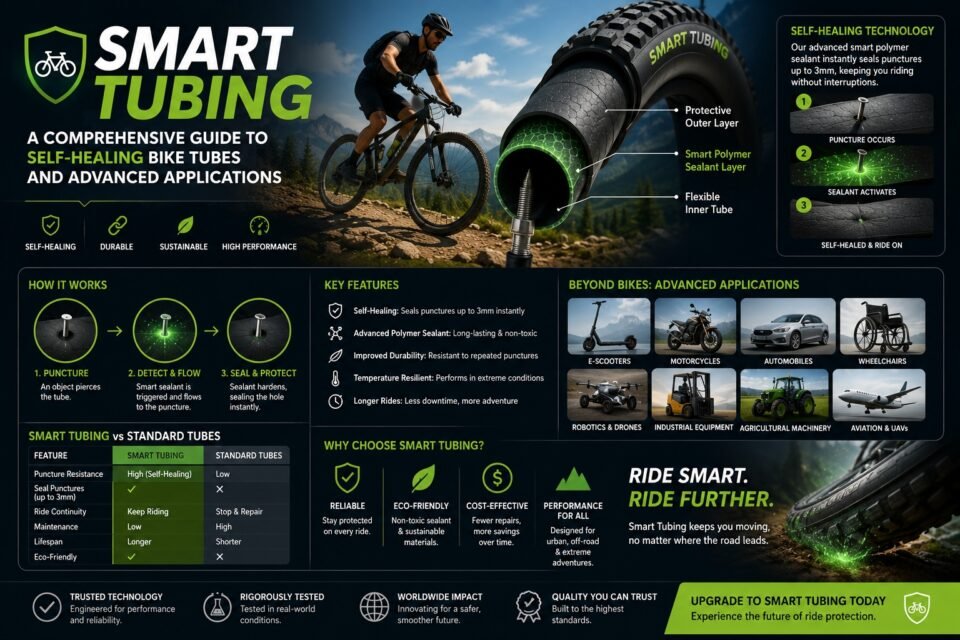

The term smart tubing has been gaining traction across multiple industries, from cycling to medical technology and oil exploration. Depending on the context, smart tubing can refer to self-healing bicycle inner tubes that instantly seal punctures, advanced medical tubing with integrated sensors and electronics, or intelligent coiled tubing systems used in oil and gas operations. This article explores the various meanings and applications of smart tubing, helping you understand what it means in different contexts.
What Is Smart Tubing? The Many Meanings
Smart tubing does not have a single, universal definition. Instead, it is a versatile term that appears across several industries, each with its own distinct interpretation:
| Interpretation | Primary Purpose | Main Users | Key Feature |
|---|---|---|---|
| Slime Smart Tube | Cycling | Mountain bikers, commuters | Self-healing inner tube that seals punctures instantly |
| Smart Medical Tubing | Healthcare | Medical professionals, patients | Tubing with integrated sensors and electronics for monitoring |
| Intelligent Coiled Tubing | Oil and gas | Drilling operators | Real-time downhole data transmission for well intervention |
| Smart Connectors | Various industries | Engineers, manufacturers | Tubing that doubles as a data conductor |
Understanding the context is essential to figuring out which meaning someone intends when they mention smart tubing.
Smart Tubing in Cycling: The Self-Healing Inner Tube
The most consumer-facing interpretation of smart tubing comes from the cycling world. Slime’s Smart Tube is a self-healing inner tube designed to prevent punctures from ruining your ride .
How Smart Tubes Work
The Smart Tube is factory-filled with a precise volume of Slime Tube Sealant . When a puncture occurs—up to 1/8 inch in diameter—the escaping air carries the sealant to the hole. The liquid portion escapes while fibers and binders build up and intertwine to form a flexible plug that instantly seals the puncture .
The self-healing mechanism works best while the wheel is spinning, as centrifugal force helps spread the slime around the inside of the tube . The sealant remains effective for up to two years, providing long-lasting puncture protection .
Real-World Performance
Independent testing of Smart Tubes has confirmed their effectiveness. In one test, a rider deliberately rode over a drawing pin and continued cycling. The pressure dropped from 100psi to 80psi, but the rider could keep going without trouble. When the pin was removed, the pressure dropped further to 60psi but still allowed continued riding .
In practical use, a tester running Smart Tubes on a winter training bike for several months on dirty roads reported no punctures .
Weighing the Pros and Cons
Advantages:
Significantly reduces the chance of punctures
Ideal for winter riding, commuting, and touring where punctures are common
Easy to fit—installation is exactly the same as a normal tube
Provides peace of mind on the road
Disadvantages:
Heavier than standard tubes (approximately 170g, 50-100g more than usual)
Slightly less lively ride feel
More expensive than normal tubes (around £9.99 retail)
May require drilling out valve holes if using Schrader valves with rubber-coated stems
For cyclists, smart tubing offers a practical trade-off: a bit of extra weight and cost for dramatically reduced puncture risk.
Smart Tubing in Healthcare: Integrating Electronics and Sensors
In the medical field, smart tubing represents a revolutionary advancement in patient monitoring and treatment. Companies like RAUMEDIC are developing tubing components that integrate electronics and sensor technology directly into the tubing material .
The Embedded Tube Connector
One of the most innovative examples of smart tubing in healthcare is the Embedded Tube Connector. This technology converts the tubing itself into a data conductor, eliminating the need for separate cables and connectors .
Key features include:
Full integration of sensors and electronics directly into the tube material
Efficient data acquisition and power supply directly via the tubing
Less cabling means better handling and greater reliability
Fewer sources of error thanks to user-friendly design
Scalable and automatable production technology
Sensor Array Technology
RAUMEDIC has also developed a sensor mat based on pixel-like arranged force sensors that can be customized in geometry and performance. This technology has applications in pharmaceutical filling processes, where it can monitor the size, shape, and position of drug bags, ensure correct unfolding, and detect critical conditions such as overstretching or leaks .
This approach to smart tubing represents a major step forward in digitalizing and optimizing medical technology products, making them more reliable, efficient, and transparent .
Smart Tubing in Oil and Gas: Intelligent Coiled Tubing
In the energy sector, smart tubing often refers to intelligent coiled tubing (ICT) systems that use real-time downhole data to improve operational efficiency and performance .
What Is Intelligent Coiled Tubing?
Conventional coiled tubing systems rely only on surface data to monitor and predict downhole conditions, which limits their effectiveness and accuracy. Intelligent coiled tubing interventions, however, use real-time downhole data to solve operational problems as they occur .
Three Types of Smart Coiled Tubing Systems
Based on the different telemetry systems, Intelligent Coiled Tubing technology can be categorized into three systems :
Tube-Wire System
Fiber-Optic System
Hybrid Electric-Optical Cable System
These systems feature surface equipment, bottom hole assemblies, downhole sensors, and real-time monitoring capabilities that enable better decision-making during operations .
Benefits of Smart Coiled Tubing
The adoption of smart tubing in oil and gas operations delivers significant value :
Real-time monitoring, diagnosis, and decision-making functions that solve operational problems in real-time
Improved operational efficiency through better control and data analysis
Extended tool life by optimizing operating parameters
Reduced downhole accidents through better risk management
Increased production because of parameter optimization and correct decision-making
Semi-Autonomous Control Systems
A case study from Colombia demonstrates the power of smart tubing in oil operations. A semi-autonomous control system was developed to optimize coiled tubing operations by extending string service life .
The system determines appropriate injector traction and reel tension forces based on real-time physics-based models. During a field trial, the system automatically applied appropriate pressures and continuously adjusted forces based on real-time model outputs .
This approach represents an advancement in coiled tubing automation, delivering practical value through model-driven force application, thereby extending equipment life .
Through-Tubing Smart Completion Solutions
Another development in smart tubing is the through-tubing smart completion solution. This novel wired and powered tubing system enhances smart completions by eliminating external cable connectors and protectors .
Key innovations include:
A protected cable pathway inside the tubing using an internal galvanic slip-ring type connector and conduit
Elimination of external cable connectors and protectors, reducing installation time
Minimization of non-productive time during completions
Improved reliability over existing smart completions
This technology has achieved Technology Readiness Level 4 (TRL 4), with further testing planned to advance to TRL 5 and 6 .
Comparison of Smart Tubing Applications
| Aspect | Slime Smart Tube | Medical Smart Tubing | Intelligent Coiled Tubing |
|---|---|---|---|
| Industry | Cycling | Healthcare | Oil and gas |
| Primary Function | Puncture prevention and repair | Patient monitoring, data transmission | Well intervention, real-time monitoring |
| Key Technology | Self-healing sealant | Integrated sensors, electronics | Fiber optics, telemetry systems |
| User Benefit | Fewer flats, peace of mind | Better handling, greater reliability | Improved efficiency, reduced costs |
| Cost | Higher than standard tubes | Significant R&D investment | Major capital expenditure |
Conclusion: The Future of Smart Tubing
Smart tubing represents a fascinating convergence of innovation across multiple industries. In cytegrated sensor scling, self-healing tubes provide puncture-free riding and peace of mind . In healthcare, smart medical tubing with in enables better monitoring and greater reliability oil and gas, intelligent coiled tubing systems deliver real-time data for more efficient and safer operations .
What all these applications share is the goal of making tubing—whether for air, fluids, or data—more intelligent, responsive, and useful. As technology continues to advance, the definition of smart tubing will likely expand further, incorporating new capabilities and serving new purposes across even more industries.